What Is an SMS Gateway? Complete Guide for 2026
Learn what an SMS gateway is, how it works, what it costs, and how to choose the right SMS gateway provider for transactional or marketing SMS in 2026.
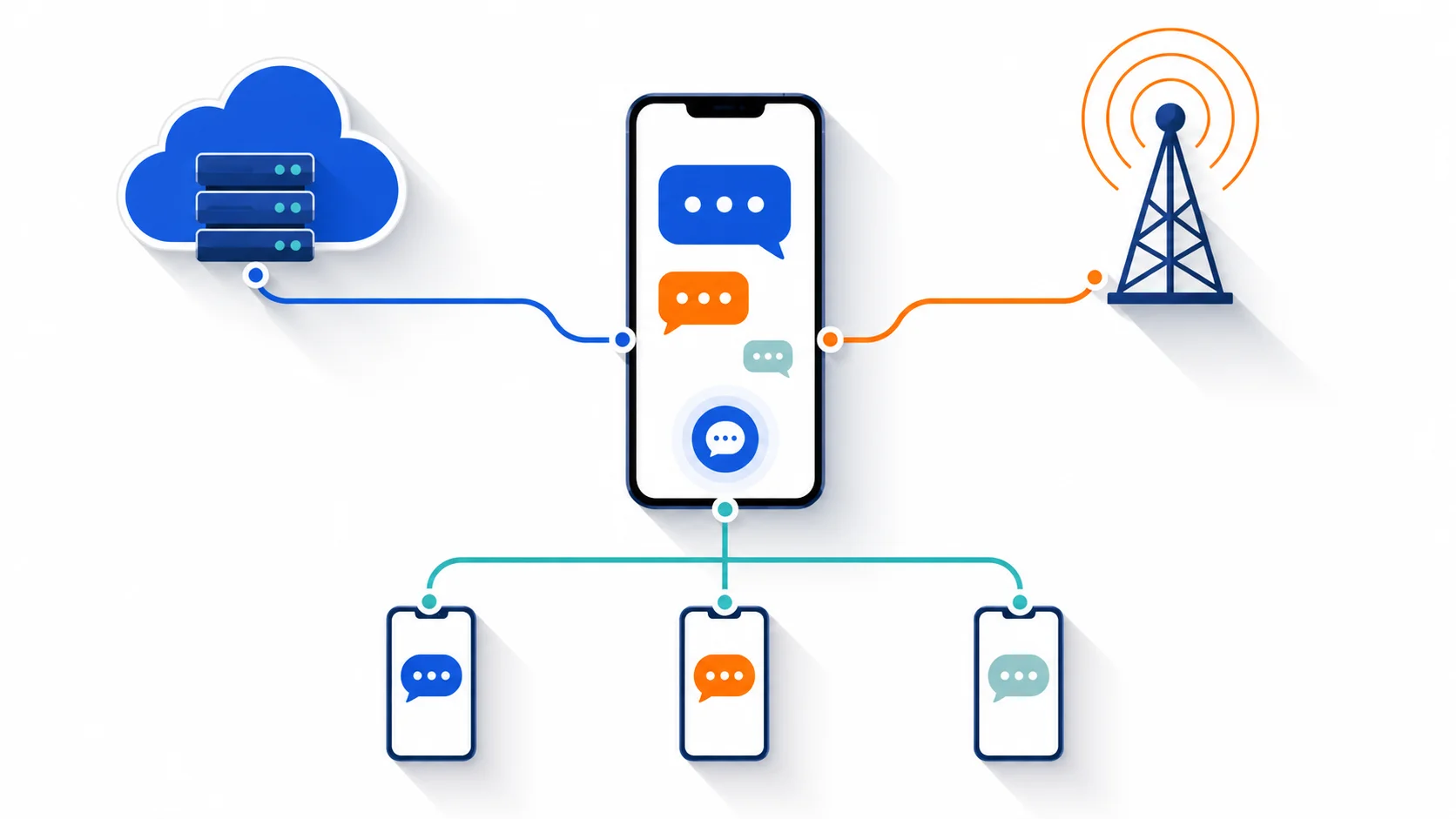
Pick the wrong SMS gateway and your messages cost more, take longer to arrive, or quietly fail in half the countries you sell to.
The GSMA puts global A2P (application-to-person) volume in the trillions per year. Almost all of that traffic rides through an SMS gateway. So the gateway you pick decides a lot.
Why does one provider quote $0.0075 per SMS and another quote $0.04 to the same number? It comes down to how each gateway is wired to the carriers underneath. Same answer for why some messages land in two seconds and others take fifteen, or never show up at all.
This guide is what we wish someone had handed us when we first integrated SMS into WordPress. It covers what a gateway actually is, how the plumbing works, the four flavours you’ll run into, what they cost in 2026, and a checklist for picking one without regretting it six months later.
Key takeaways
- An SMS gateway is the bridge between your application and the mobile carriers that put text messages on phones.
- Most modern gateways speak HTTP/REST. High-volume senders also use SMPP, which holds a persistent TCP connection to the carrier.
- US outbound rates typically sit between $0.0075 and $0.04. Country surcharges can change that picture quickly.
- Five things matter when you compare gateways: country coverage, whether the route is direct or aggregated, pricing transparency, sender-ID rules in your destination markets, and the API features you’ll actually use.
- WSMS plugs WordPress into 300+ SMS gateway providers, so swapping one out doesn’t mean swapping platforms.
What is an SMS gateway?
An SMS gateway is a service that lets software send and receive text messages over the cellular network. Your app fires off a request, usually over an API. The gateway translates that request into something carriers can understand and hands it to the recipient’s mobile operator for last-mile delivery. Wikipedia’s SMS gateway entry gives the textbook version with extra history if you’re curious.
Without a gateway, your application can’t talk to mobile carriers at all. There’s no “open a TCP connection to AT&T” button. The gateway hides three messy layers: the carrier protocols themselves (SMPP, SS7, SIP), the routing agreements between operators, and a long tail of country-specific rules around sender IDs, opt-in evidence, and content filtering.
You’ll hear “SMS gateway” used in two slightly different ways. Sometimes people mean the technical bridge: the piece of software that turns an HTTP request into a carrier-bound message. Other times people mean the company selling access to that bridge: Twilio, MessageBird (now Bird), Plivo, Vonage, Sinch, Kavenegar, Unifonic, and so on. For buying decisions the two are basically the same thing, and that’s how this guide uses the term.
How an SMS gateway works
A single outbound SMS makes five hops:
- Your application calls the gateway’s API. You pass the recipient number, the sender ID, and the body.
- The gateway validates the request and queues it. That includes checking the number format, opt-in status in regulated markets, and content filters.
- It routes the message to a carrier connection. A direct gateway has a contract with the destination carrier. An aggregator gateway resells access through a wholesaler.
- The carrier’s SMSC (Short Message Service Center) accepts the message and pushes it to the recipient’s handset over SS7 or Diameter signaling.
- The handset returns a delivery receipt (DLR). The gateway forwards that back to your application via webhook.
Inbound SMS follows the same path in reverse. The carrier’s SMSC hands the message to the gateway, and the gateway calls a webhook on your side.
Encoding matters at step 1. A plain SMS is 160 characters in GSM-7. The moment your message contains non-Latin script (Arabic, Persian, Chinese, an emoji) the limit drops to 70 characters, because the message switches to UCS-2 encoding. Gateways detect that automatically and split anything longer into concatenated parts. They also bill per part, which is a fact people miss until the first invoice arrives.
Types of SMS gateways
Not every gateway works the same way. Four flavours cover almost everything you’ll see in production.
HTTP / REST API gateways
The dominant model in 2026. You POST a message to a JSON or form-encoded endpoint and get back a message ID and a status. Easy to integrate, easy to firewall, works from any language. Twilio, Plivo, and most regional providers ship this kind of API.
SMPP gateways
Short Message Peer-to-Peer (SMPP) is the carrier-grade protocol for SMS. It holds a persistent TCP connection and pushes far more throughput than HTTP, often hundreds of messages per second per bind. If you’re sending more than ~100,000 messages per day, or you need strict ordering and delivery guarantees, SMPP is the default. The SMPP 5.0 specification is an open standard, and every serious aggregator supports it.
Email-to-SMS gateways
Some carriers expose gateways that accept email at addresses like [email protected] and forward the body to that number as an SMS. Cheap, fine for a test, but rate-limited and being deprecated by US carriers. Don’t run anything important on it.
Direct carrier connections
Enterprises pushing very high volume sometimes integrate straight with a mobile network operator over SMPP or SS7. That removes the aggregator’s margin and improves deliverability, but the contracts, technical setup, and minimum-volume commitments aren’t realistic for most businesses. The big gateway providers are doing this on your behalf.
What businesses actually use SMS gateways for
Six use cases account for most paid SMS volume.
- Transactional alerts: order confirmations, shipping updates, password resets, appointment reminders. Highest deliverability priority. Users opt in implicitly by transacting.
- Two-factor authentication (2FA): one-time passwords for login or payment confirmation.
- Marketing campaigns: promotions, abandoned-cart reminders, loyalty offers. These are regulated by the Telephone Consumer Protection Act (TCPA) in the US and GDPR in the EU, plus explicit opt-in laws in most other markets.
- Customer support: two-way SMS for bookings, status questions, post-purchase follow-up.
- Internal alerts: server downtime pages, fraud alerts, staff notifications.
- RCS messaging: the richer successor to SMS, with images, buttons, and read receipts. Most modern gateways now support both. Our guide to RCS messaging goes into the differences.
SMS gateway pricing in 2026
Gateway pricing has three components: a per-message cost, sender-ID registration fees, and sometimes a monthly platform fee.
| Region | Typical outbound rate | Inbound rate |
|---|---|---|
| US / Canada (long code) | $0.0075–$0.0150 | $0.0075 |
| US (toll-free) | $0.0150–$0.0250 | $0.0075 |
| US (short code) | $0.0040–$0.0100 + monthly lease | $0.0075 |
| UK | $0.040–$0.055 | included |
| Germany / France | $0.075–$0.100 | included |
| Saudi Arabia / UAE | $0.030–$0.080 | varies |
| India (transactional) | $0.0020–$0.0040 | included |
Numbers are rounded from public list prices on the big aggregators (for example Twilio’s US pricing page). Your real rate depends on volume tier, sender-ID type, and route quality.
A few cost gotchas that catch people:
- Concatenation. A 250-character marketing message bills as two SMS parts, not one.
- Unicode. A short Arabic message can still fit in one part, but it hits the 70-character wall much faster than a Latin one. Plan for 2-3 parts on most non-Latin marketing copy.
- Sender-ID registration. US 10DLC numbers carry a one-time brand and campaign vetting fee in the $4-$50 range, plus monthly campaign fees of $1.50-$10 each.
- Country surcharges. Some networks in parts of West Africa and the Caribbean tack on $0.10 or more per message.
For a working budget estimator, our WSMS pricing page includes per-country gateway cost examples you can compare.
How to choose the best SMS gateway
Run any two providers through these eight questions before you sign anything.
- Country coverage. Does the gateway have a route to every country your customers actually live in? “Global coverage” is marketing language. Ask for the real country list with route type next to each one.
- Route quality. Direct routes deliver faster (typically under 5 seconds) and have higher arrival rates. Aggregator routes are cheaper but can drop messages silently in restrictive markets like UAE or Iran.
- Pricing transparency. Is the per-country price list public? Hidden country surcharges are the most common buyer complaint we hear.
- Sender-ID rules. Alphanumeric sender IDs like “WSMS” work in most of Europe and the Middle East. They’re blocked in the US and Canada, which require a 10DLC long code, a toll-free number, or a short code. Make sure the gateway supports whatever your destination market needs.
- Compliance support. Will the provider help you with TCPA opt-in records, GDPR consent logs, India DLT registration, and Saudi CITC sender-ID approval? A non-compliant route can land your sending domain on a carrier blocklist, and that’s painful to recover from.
- API and SDK quality. REST plus webhooks is the floor. Look for idempotency keys, batch send, scheduled send, two-way receipts, and a real sandbox environment.
- Throughput limits. The published messages-per-second number should comfortably exceed your peak campaign load. Twilio’s default 10DLC throughput is 1 MPS. High-volume tiers go to 100+ MPS.
- Fallback paths. Anything production-grade routes through two or more gateways and fails over on errors. Multi-gateway support is one reason people pick WSMS.
The “best” gateway is the one that passes all eight checks for your country mix, your volume, and your use case. Not the one with the cheapest sticker price.
How to integrate an SMS gateway with WordPress
If your site runs on WordPress, you don’t need to build the integration. The WSMS plugin connects WordPress to 300+ providers through a single settings screen. Twilio, Plivo, MessageBird, Vonage, Kavenegar, Unifonic, ClickSend, plus most of the regional players. The full list is at wsms.io/gateways.
Setup usually takes under five minutes:
After that, every WSMS feature runs through that gateway automatically: WooCommerce order notifications, password resets, subscriber broadcasts, 2FA. You don’t have to wire anything per-feature.
If you’re building a custom integration outside WordPress, the minimal code path is roughly the same across providers. Here’s a Twilio HTTP example:
curl -X POST "https://api.twilio.com/2010-04-01/Accounts/$ACCOUNT_SID/Messages.json" \
  --data-urlencode "From=+15551234567" \
  --data-urlencode "To=+447123456789" \
  --data-urlencode "Body=Your order #1234 has shipped" \
  -u "$ACCOUNT_SID:$AUTH_TOKEN"
The shape is identical on every modern HTTP/REST gateway: auth, from, to, body. Switching providers is usually a matter of swapping the endpoint and the credential names.
SMS gateway vs. messaging API: are they the same?
Mostly yes, with one wrinkle. “Messaging API” has turned into an umbrella term for providers that bundle SMS, MMS, RCS, WhatsApp Business, and sometimes voice into one API. The SMS gateway is the SMS-specific slice of that stack. If you only need text messages, a focused SMS gateway is simpler and usually cheaper. If you need multi-channel logic, like “try WhatsApp first, fall back to SMS”, go with a full messaging-API provider.
Bottom line
An SMS gateway is plumbing. Invisible when it works, painful when it doesn’t. The one you want covers every country your customers live in, handles your peak throughput without rate-limiting you, complies with the rules in each destination market, and slots into your existing stack without custom code.
If your SMS lives on top of WordPress, browse the 300+ gateways WSMS supports and pick one that fits your destinations and budget. Or check WSMS pricing to see what an end-to-end WordPress + SMS setup actually costs.
Frequently asked questions
Is an SMS gateway free?
A handful of providers offer free trial credit ($10-$20 of test sends), and the old carrier email-to-SMS gateways are technically free. Anything you’d run in production is paid. Budget $0.005 to $0.10 per outbound message depending on country and route.
Can I send SMS without an SMS gateway?
Not from an application, no. Personal phones talk to the carrier directly. Software has no way to do that without a gateway in between. Even an Android handset running a “send from server” app is acting as a personal gateway, just a slow and unreliable one.
What’s the difference between an SMS gateway and an SMS aggregator?
An aggregator buys carrier access in bulk and resells it. Most SMS gateways are aggregators: they connect to many carriers and route each message down the cheapest viable path. A direct gateway has its own contracts with specific carriers, which usually means better delivery rates at a higher price.
Do SMS gateways support two-way SMS?
Yes. Every major HTTP/REST gateway in 2026 supports inbound SMS through webhooks. Your app receives a POST request whenever a customer replies. Some gateways charge for inbound, others include it.
What is the SMS gateway API?
It’s the HTTP endpoint your application calls to send a message. The standard pattern is POST /messages with JSON or form-encoded fields for from, to, and body. The response gives you a message ID and a queued status. Delivery status arrives separately on a webhook you register when you sign up.